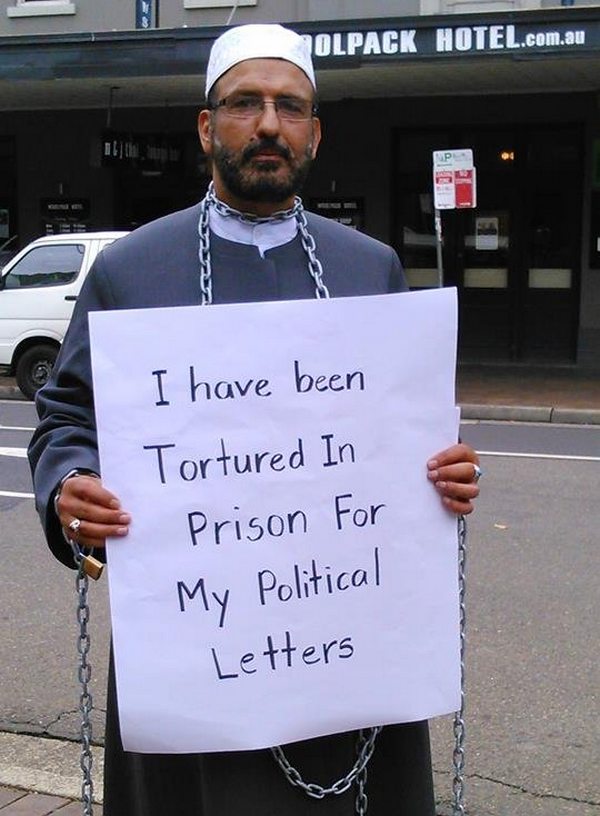
Gordon: Monis had engaged in street theater in Sydney garbed in Sharia compliant gabilas trussed in chains saying that he had been tortured while in custody. Is that typical behavior for someone convicted of violent crimes?
Welner: No it is not. Violent crime carries with it a variety of motivations, from financial predation to revenge to sexual opportunism, for example. Violent criminals are not typically driven to call attention to themselves. Such a personality is one whose attention-seeking has been useful enough to him in other instances to have reinforced this behavior, particularly during times in which he otherwise faces substantial life challenges.
Gordon: Monis and his companion Droudis had been engaged in a campaign of scurrilous letters sent to the grieving parents of Australian soldiers killed in the Afghanistan conflict. Were they motivated by Islamic doctrine or self promotion to draw attention to a reprehensible cause and for what gain?
Welner: There are many ways for one to express opposition to the Australian military role in Afghanistan, and many Muslims and non-Muslims do so. For those motivated to write, there are an endless supply of media outlets and other public forums in which their ideas can be aired and can influence others. The fact is that these letters were likely far less obscene than what one finds in the comments sections of relevant news articles published on the internet; or, what folks tweet. Furthermore, considering Monis was hoping to influence others, the quality of his correspondence would never have influenced their recipients.
Compassionate appeals to mourning families to reconsider their politics would never have resulted in criminal prosecution. Americans recall Cindy Sheehan and how her grief was massaged by antiwar activists, along with Ms. Sheehan’s own pathological need for the public eye, into photo-ops to embarrass the President waging war. But even a man like Monis, sophisticated enough to tout himself as a peace activist, used the vector of his contact with grieving families to mock and to maximize their pain. What gives?
It was, in my professional opinion, the stunt of having engaged grieving parents that was more important to Monis than the letters and their content. It was all about the spectacle.
Gordon: Droudis and Monis also sent a letter to the parents of a fallen Australian Jewish soldier likening him and all Jews to Hitler. Is this a reflection of primal Islamic Antisemitism or morally reprehensive behavior to attract notoriety?
Welner: It is neither. Jews are, sadly, reflexively defensive to others who draw parallels of Jews and especially Israel’s behavior to that of the Nazis. The comparisons require complete ignorance of history, which most Jews do not have, at least of this generation. However, Jews are afflicted as a general rule with self-doubt. Leftist Jews in particular identify with their aggressors the way a very sick rape victim blames herself for the attack.
No doubt some leftist Jews in Germany during Hitler’s rise did as much to the end that they convinced themselves, at least until they were in line waiting to be gassed, that Nazism had some basis in legitimate grievance. And more recently, the capitulationist attitudes of some Israelis, even in the face of thinly-veiled and sometimes undisguised Palestinian irredentist desires to exterminate every last Jew from the area, reflect the same pathological self-doubt.
Nazi-comparison imagery is routinely utilized by Palestinians, their advocates in the Arab World, among anti-Semites in the European-dominated intellectual circles and even among those self-loathers in Jewish intellectual circles who seek the approval of the aforementioned. It transcends hatred. Rather, this is done because invoking Hitler is an effective rhetorical device to manipulate the self-doubt tic that is the sad pathology of the psyche of so many Jews in positions of intellectual and political influence, including in Australia.
Read the full article here.
Read past interviews with Jerry Gordon here.


